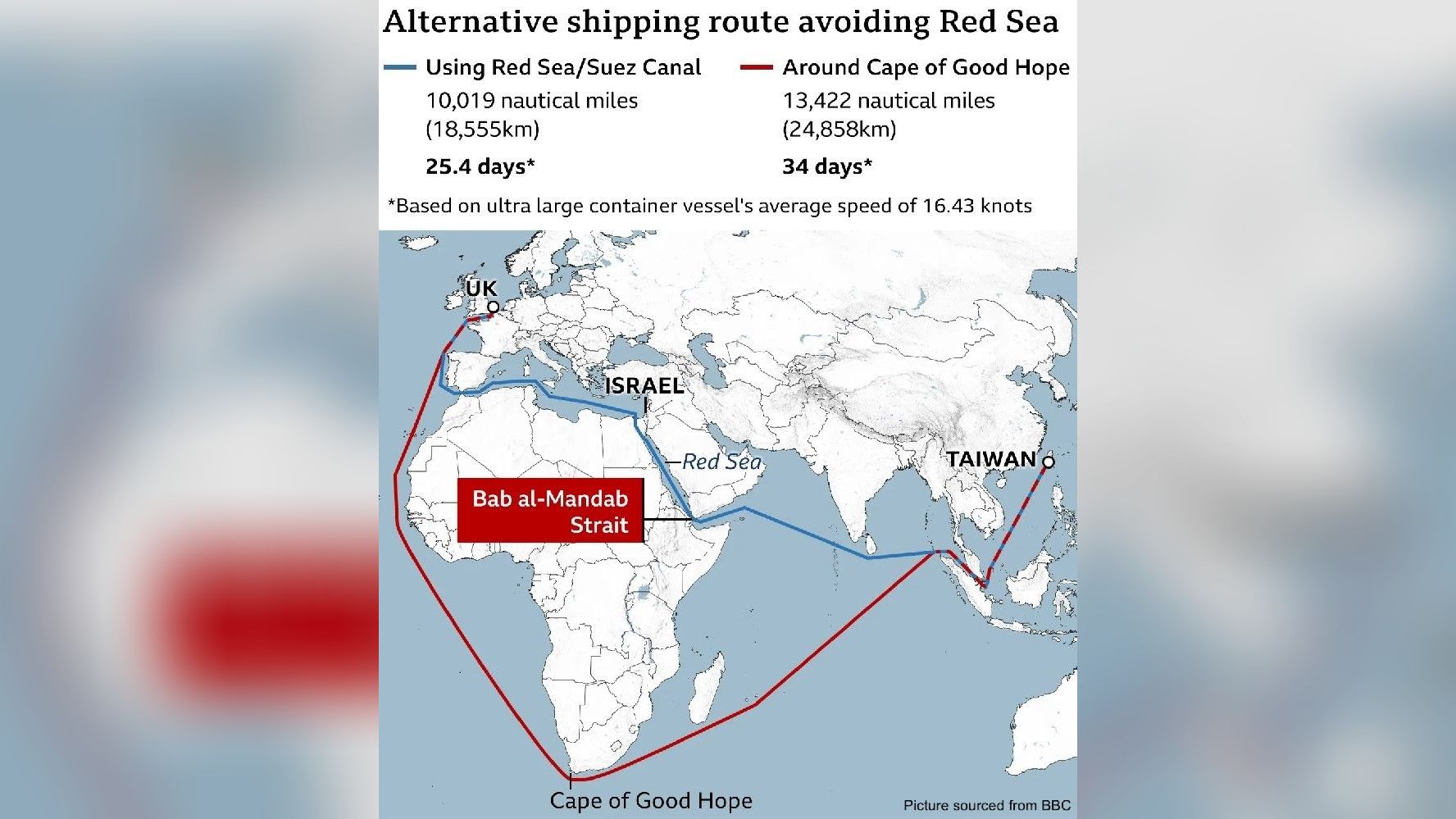
In recent times, incidents of ship attacks in the Red Sea, the Strait of Mandeb, and nearby waters have occurred frequently. Several container shipping companies have successively announced the suspension of their container ships' navigation in the Red Sea and nearby areas. How serious is the crisis in the Red Sea waterway, and what impact will the tense situation have on the global shipping industry and the world economy?
Question 1: Which cargo ships are suspending navigation in the Red Sea?
From December 15 to 16, the Mediterranean Shipping Company of Switzerland, Maersk Group of Denmark, CMA CGM Group of France, and Hapag-Lloyd of Germany announced the temporary avoidance of the Suez Canal route that passes through the Red Sea. This means that four of the world's five largest shipping companies will avoid the Red Sea waterway, accounting for 53% of the global container shipping market. On December 18, British Petroleum, the National Oil Company of Norway, and several shipping companies in Norway and Belgium also announced that their vessels would avoid routes in the Red Sea and the Gulf of Aden.
Question 2: How important is the Red Sea waterway?
The Suez Canal-Red Sea international shipping passage, connecting the Red Sea and the Mediterranean, is one of the world's busiest waterways. The Strait of Mandeb, located at the southern end of the Red Sea, serves as a vital passage for ships traveling between the Indian Ocean and the Atlantic Ocean. About 17,000 ships navigate the Strait of Mandeb each year, handling approximately 10% of global trade. With the Panama Canal currently facing severe drought and reduced navigational capacity, the Suez Canal has become increasingly important for global trade and shipping.
Question 3: What does it mean for cargo ships to detour around the Cape of Good Hope?
The Suez Canal Authority in Egypt revealed that since November 19, 55 ships have chosen to circumnavigate the southern tip of Africa, the Cape of Good Hope. Circumnavigating the Cape of Good Hope could lead to an increase in sailing time by 6 to 14 days, impacting delivery times and shipping costs. For a cargo ship sailing from Rotterdam to Singapore, circumnavigating the Cape of Good Hope instead of using the Suez Canal would increase the journey by 40%, burning more fuel and delaying arrival by a week or more, causing container backlogs at ports.
Question 4: What Impacts Will the Red Sea Crisis Bring?
Analysts believe that if tension in the Red Sea and surrounding areas intensifies, causing continued disruption to international shipping, the global supply chain will inevitably suffer. Global container freight prices and oil prices rose in response — after British Petroleum announced the suspension of Red Sea transportation, oil prices rose by nearly 2%. These changes are significant because they increase the costs of almost everything that relies on maritime transport.